
Aug
Wholesale
Bulk Kratom from Indonesia: A Sourcing Guide for International Wholesale Buyers
Buyers looking to source bulk kratom from Indonesia need to check five things upfront: export-import legality, written product specifications, laboratory test results (COA), supply capacity and consistency, and shipping documentation that matches destination-country regulations. These five elements determine whether a supplier is a viable long-term partner or just a risky short-term source.
Indonesia has long been the world’s primary kratom supplier, with most production coming from West Kalimantan and Sumatra. According to reporting cited by Inverse (2019) from Bloomberg and AFP, most kratom sold in the United States originates in Indonesia, with roughly 90% of West Kalimantan’s output exported to that market.
That said, this supply dominance doesn’t guarantee uniform quality. Every supplier has different processing, testing, and documentation standards, so evaluation remains the buyer’s responsibility before any bulk transaction.
Table of Contents
Why Buyers Choose Bulk Kratom from Indonesia
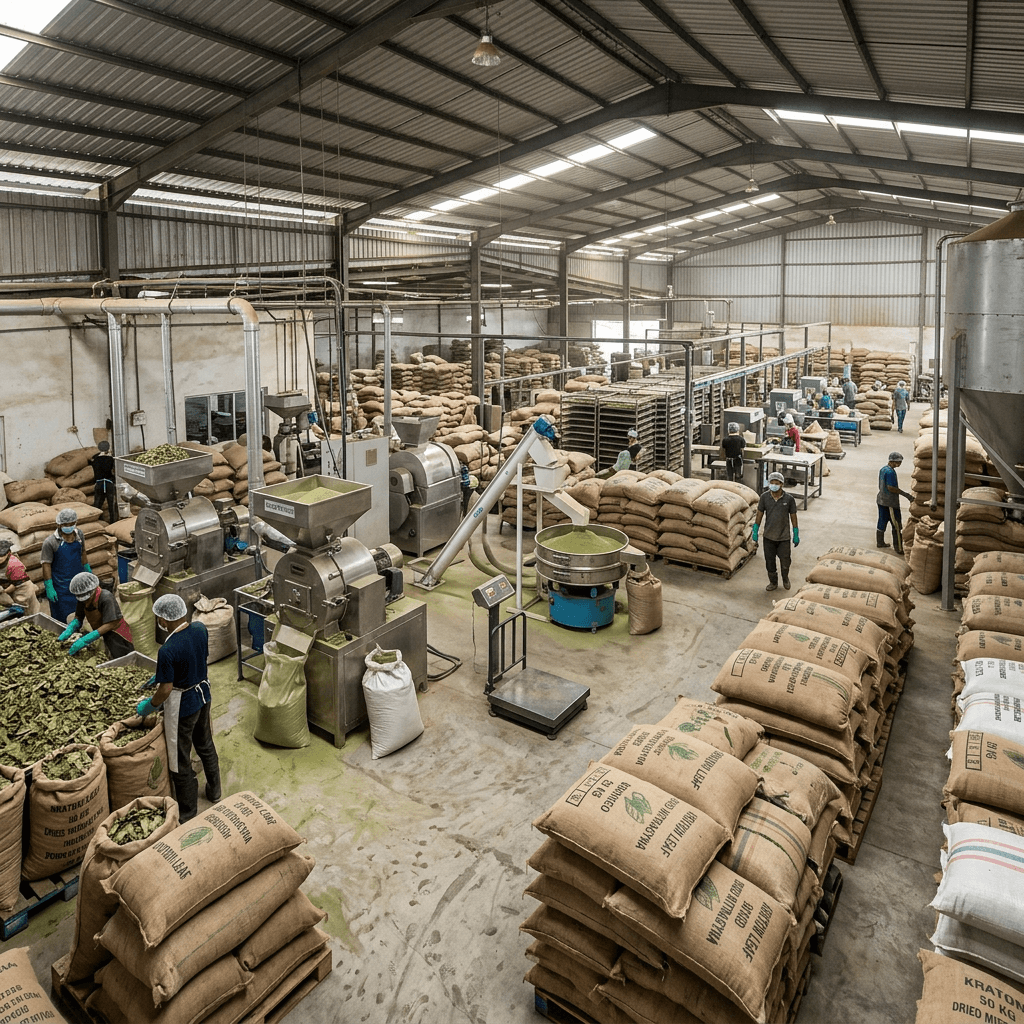
International buyers generally choose Indonesia because of the raw material availability from the plant’s native range in Southeast Asia, particularly Kalimantan and Sumatra. The region’s climate and long-standing cultivation experience make the supply chain relatively more stable than alternative sources.
That availability alone isn’t enough, though. Batch-to-batch specification consistency matters far more to bulk buyers than chasing the lowest price, since quality variation can affect production processes, regulatory compliance, and brand reputation in the destination market.
Bulk buyers also need a supplier who is responsive and transparent, particularly on production status, batch availability, and export documents. Before any large transaction, independent quality testing and a check of destination-country regulations remain mandatory steps, regardless of a supplier’s reputation.
In terms of market coverage, Borneohale can serve export requests to most countries worldwide, except countries that formally prohibit kratom. Buyers remain responsible for ensuring compliance with the import, distribution, and labeling regulations in effect in their own country before placing an order.
Common Bulk Kratom Product Forms Buyers Look For
The product forms available for bulk purchase follow Indonesia’s export regulations, not just market demand. Under Minister of Trade Regulation (Permendag) No. 5 of 2026 on Export Policy and Arrangements, kratom (Mitragyna speciosa) covered by export regulation includes cut, crushed, or powder form, with a maximum particle size of 600 microns — this applies to kratom intended for both pharmaceutical and non-pharmaceutical use (Source: Permendag No. 5 of 2026, Kratom Annex).
In practical terms:
- Kratom powder — the most commonly traded bulk form, and it meets the ≤600 micron particle-size limit under the regulation.
- Crushed leaf / cut form — also falls within the regulated export scope as long as particle size stays within the ≤600 micron limit; availability should still be confirmed with the supplier, since not every production facility processes this form.
- Whole leaf (uncut, uncrushed, unpowdered) — very rarely traded in bulk export and most likely not among the forms Borneohale exports on a regular basis. This form also isn’t explicitly covered under the kratom tariff lines regulated in this annex.
Because export regulations can be revised at any time, buyers should always confirm available product forms and current regulatory status with the supplier at the time of ordering, rather than relying on older information.
Beyond product form, the commercial specifications buyers should pay attention to include particle size (mesh size), moisture content, freedom from foreign matter, batch-to-batch consistency, and packaging requirements suited to the distribution channel — whether retail, wholesale, or private label.
Checklist for Choosing a Bulk Kratom Supplier from Indonesia
Before signing a contract or sending payment, B2B buyers should systematically verify the following ten aspects.
| No. | Aspect | What to Check |
|---|---|---|
| 1 | Supplier identity & legality | Business legality, clear point of contact, and valid ET Kratom (Registered Exporter — Producer/Non-Producer) and PE Kratom (Export Approval) status, per Permendag No. 5 of 2026 |
| 2 | Written product specifications | An official specification document, not just a verbal or chat description |
| 3 | COA / lab test results | COA from an independent laboratory, stating test method, test date, and mitragynine content |
| 4 | Microbiology & heavy-metal testing | Contaminant testing appropriate to the destination market’s requirements (e.g. Salmonella, E. coli, heavy metals Pb/Hg/Cd/As, moisture content) |
| 5 | Batch system & traceability | Ability to trace a batch back to its production process |
| 6 | MOQ & volume flexibility | Minimum order threshold and options to adjust volume on future orders |
| 7 | Sample before a large order | Availability of a representative sample from the batch to be shipped |
| 8 | Bulk packaging & private label | Bulk sack, drum, or custom packaging options with the buyer’s own label |
| 9 | Export documentation | Completeness of ET Kratom, PE Kratom, and Surveyor Report (LS), plus other documents matching the shipping route and destination country |
| 10 | Payment, lead time & shipping | Payment terms, estimated production time, and shipping method — including whether the PE Kratom being used still covers the planned shipment period |
This checklist serves as an initial evaluation framework. Technical detail on each point — such as additional testing types or document formats — can vary by destination country and product type.
Documents and Quality Control Buyers Should Ask About
Before finalizing an order, buyers should proactively request the following documents from the supplier rather than waiting to be offered them:
- Certificate of Analysis (COA) for the batch relevant to the order.
- Batch/lot information, including production date and raw material origin.
- Product specifications in written form that can serve as a contract reference.
- Packaging documentation, including material type and net weight per packaging unit.
- Shipping and export documents relevant to the transport mode used.
- Additional destination-country requirements, such as a phytosanitary certificate if required by local authorities.
The type and number of documents required varies by destination country, product type, shipping route (sea or air), and local regulations in effect at the time of shipment. For example, a number of European markets apply the EU plant-health regulation framework for plant-based products imported from outside the EU, so buyers in that region need to make sure phytosanitary documentation matches the requirements in effect in their importing country.
Export Legality Documents from the Indonesian Side
Beyond the documents buyers typically request, kratom exporters in Indonesia are themselves bound by three mandatory licenses under Permendag No. 5 of 2026. Knowing all three helps buyers assess whether a supplier is genuinely operating legally:
- ET Kratom (Registered Exporter) — split into ETPK (Registered Exporter – Kratom Producer, for exporters who own their own milling machines/factory) and ETNPK (Registered Exporter – Kratom Non-Producer, for exporters partnering with a producer). ET Kratom is valid for 3 years from issuance, and each exporter may hold only one.
- PE Kratom (Export Approval) — a per-shipment export license that ETPK/ETNPK holders must obtain before goods are shipped, valid for a maximum of 6 months following the semester period (January–June or July–December). Buyers with staggered shipment schedules should confirm whether the supplier’s PE Kratom still covers the planned shipment period.
- Surveyor Report (LS) — an independent technical verification required for kratom exported in cut, crushed, or powder form. The LS confirms the product meets the following parameters (Source: Permendag No. 5 of 2026, Kratom Annex):
- Minimum mitragynine content of 1.2% for green and white kratom, or 0.8% for red kratom (as evidence the product is free of foreign leaf mixture).
- Heavy metals: Lead (Pb) ≤1 mg/kg, Mercury (Hg) ≤0.5 mg/kg, Cadmium (Cd) ≤0.3 mg/kg, Arsenic (As) ≤1.5 mg/kg.
- Bacterial contamination: Salmonella negative per gram, Escherichia coli ≤10 AM/gram.
- Maximum moisture content of 10%.
Buyers can request a copy of the LS or COA referencing these parameters as part of due diligence, particularly for bulk orders intended for further distribution or use as private-label input material.
For reference, Borneohale (PT. Kreasi Alam Borneo) has applied for and holds an updated ET Kratom license in line with the July 1, 2026 deadline, along with a PE Kratom valid for the July–December 2026 period. Laboratory testing carried out routinely covers mitragynine content, microbiology, and heavy metals, in line with the LS parameters above. Borneohale also holds an official kratom export license from the Ministry of Trade (Kemendag) and is a member of PEKRINDO (the Indonesian Kratom Business Association).
MOQ, Packaging, and Private Label for Bulk Orders
MOQ (Minimum Order Quantity) and packaging options are generally shaped by several operational factors rather than a fixed number that applies universally across suppliers. These factors include:
- Product form ordered (powder is generally more flexible than other forms).
- Level of customization requested by the buyer, including blends or special specifications.
- Packaging type — bulk sacks, drums, or retail-ready packaging for private label.
- Labeling requirements, including language, mandatory information, and packaging design.
- Export destination country and its import requirements.
- Additional testing requirements before shipment.
- Order volume and production schedule availability during a given period.
Borneohale’s current MOQ is 500 kg per order, with production capacity of roughly 50 metric tons per month — so large-scale bulk orders can generally be accommodated. Borneohale also accepts private label and custom packaging requests; specific lead time still depends on batch availability at the time of ordering, so this should be confirmed directly when a buyer submits a request.
A Safer Bulk Kratom Sourcing Process for International Buyers
In general, a more structured bulk kratom sourcing process can follow this flow:
- Buyer sends product requirements, volume, and destination market to the supplier.
- Both parties confirm legality and import requirements in the destination country.
- Both sides discuss product specifications and required documents.
- Buyer evaluates a sample and/or COA before proceeding to a large order.
- Price, MOQ, packaging, and transaction terms are finalized in writing.
- Supplier carries out production, quality control, and shipment preparation.
- Shipment takes place along with the appropriate export documentation.
This flow is general and can be adjusted based on the buyer’s specific needs, product type, and the regulations in effect in the destination market at the time of the transaction.
Why Supplier Communication Matters in Bulk Purchasing
In bulk transactions, clear communication is often what separates a reliable supplier from an unreliable one. Things that need to be communicated consistently include product specifications, production status, batch availability, changes to regulations or document requirements, private-label needs, and responsiveness to buyer questions.
Buyers working with suppliers in Indonesia should factor in that kratom export regulations can change, so transparency about current regulatory status is an important part of sourcing — not just a matter of price and volume.
The Borneohale team is available to discuss product specification needs, volume, packaging options, and export documentation tailored to each buyer’s needs, as part of the evaluation process before a transaction takes place.
Conclusion and Next Steps
Safer bulk kratom sourcing from Indonesia should be grounded in clear product specifications, complete documentation, consistent quality control, compliance with destination-country regulations, and transparent supplier communication. The checklist and process flow above can be used as a starting framework for evaluating any prospective supplier, including Borneohale.
Buyers who want to discuss product specification needs, order volume, private-label or custom packaging options, COA, or documentation requirements for their target market can reach the Borneohale team at info@borneohale.com, or via our Contact page, to begin the evaluation process.
FAQ About Bulk Kratom from Indonesia
What should I check before buying bulk kratom from Indonesia?
Buyers should check supplier legality — including valid ET Kratom (ETPK/ETNPK) and PE Kratom status under Permendag No. 5 of 2026 — written product specifications, COA from an independent laboratory, batch traceability, and complete export documentation that matches destination-country regulations.
Can buyers request a COA or lab test results?
Yes. A COA for the batch relevant to the order is a standard document buyers can request before or during the sample evaluation process.
What is the MOQ for bulk kratom from Borneohale?
Borneohale’s current MOQ is 500 kg per order. For needs outside that figure, buyers can discuss directly with the Borneohale team.
Is private label or custom packaging available?
Yes, Borneohale accepts private label and custom packaging requests. Technical details, minimum volumes, and costs for these options can be discussed directly with the Borneohale team based on the buyer’s needs.
What documents are needed to import kratom?
On the buyer’s side, required documents vary by destination country but generally include a COA, shipping documents, and additional requirements such as a phytosanitary certificate if required by the importing country’s authorities. On the Indonesian side, a legitimate supplier must hold ET Kratom, PE Kratom, and a Surveyor Report (LS) under Permendag No. 5 of 2026 — buyers can request proof of these documents as part of legality verification. Buyers remain responsible for ensuring compliance with the import, distribution, and labeling rules in effect in their destination country.
Discover more from Borneohale
Subscribe to get the latest posts sent to your email.

You may also like these articles…
Guide
White Maeng Da Kratom: The Most Enjoyable and Stimulating Strain
The world of kratom is fascinating, and White Maeng Da is one of the most[Read More]
Read MoreGuide
Green Maeng Da Effects: Phenomenal and Friendly for New Users
Green Maeng Da effects are phenomenal. It is one of the safest antidepressant plants, and[Read More]
Read MoreBest Seller Product
Kratom
Green Kratom Powder
Kratom
Red Kratom Powder
Kratom
White Kratom Powder