
Aug
Sourcing
CHAMPS Trade Show Kratom Suppliers: 7 Essential Strategies for Trusted B2B Positioning
CHAMPS Trade Show kratom suppliers have a practical opportunity to strengthen distributor relationships, demonstrate responsible sourcing, and improve market positioning at an influential B2B industry event. CHAMPS Las Vegas Summer 2026 is scheduled for August 26–28, 2026 at the Las Vegas Convention Center, with an advocacy presentation reportedly planned for August 27. For bulk suppliers, the key value is not consumer promotion—it is disciplined B2B networking, documentation readiness, and credible communication with qualified trade buyers.
Trade shows can put suppliers, brand owners, distributors, retailers, service providers, and advocacy stakeholders in the same room. A well-prepared kratom exporter can use this setting to explain how its supply chain, quality controls, product specifications, and commercial practices support responsible market access.
Table of Contents
Why CHAMPS Trade Show Kratom Suppliers Should Pay Attention
For kratom businesses, CHAMPS is more than a place to display products. It can be a structured environment for meeting prospective distributors and understanding the questions that shape purchasing decisions in the United States and other regulated markets.
The reported August 27 advocacy presentation also highlights an important commercial reality: regulation, public perception, and responsible industry conduct can influence the operating environment for every business in the kratom supply chain. Suppliers should listen carefully to the concerns raised by distributors and advocacy organizations without overstating the event’s legal or policy impact.
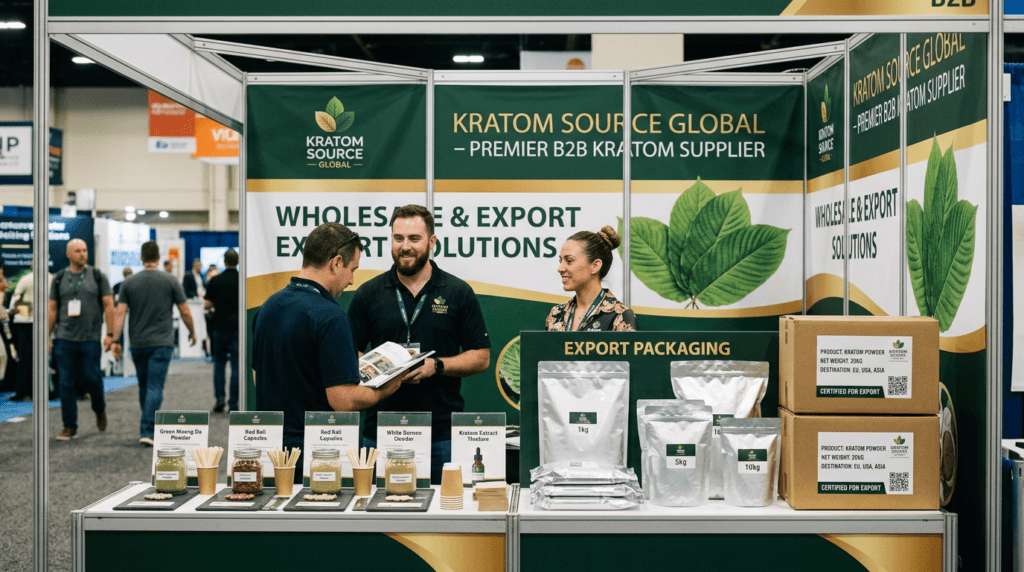
For CHAMPS Trade Show kratom suppliers, the goal should be to build long-term B2B trust. That means presenting verifiable operational capabilities rather than relying on broad claims about demand, quality, or compliance.
- Meet established distributors and identify their procurement requirements.
- Discuss bulk product specifications, packaging formats, and private-label capabilities.
- Demonstrate batch traceability and available laboratory documentation.
- Learn how buyers are managing labeling, marketing, and regulatory risk.
- Position the supplier as a consistent, transparent export partner.
1. Use the Event for Qualified Distributor Networking
The most productive conversations at a trade show are selective. Rather than collecting as many contacts as possible, suppliers should identify companies that have a clear distribution footprint, relevant product categories, and a documented interest in importing or sourcing kratom products.
Before attending, create a target list of distributors, brand owners, and private-label operators. Review whether they work with botanical products, operate in appropriate markets, and have purchasing volumes that align with the supplier’s production capacity.
CHAMPS Trade Show kratom suppliers should also prepare a concise buyer profile for each meeting. This profile can include intended destination market, packaging needs, preferred product forms, expected documentation, anticipated order volume, and lead-time expectations.
2. Position Responsible Sourcing as a Commercial Standard
Responsible positioning should be concrete. B2B buyers need to understand how a supplier manages raw-material procurement, post-harvest handling, processing conditions, lot identification, storage, and export preparation.
A supplier should avoid vague statements such as “best quality” or “fully compliant” unless those claims are supported by defined evidence. Instead, explain the systems used to control quality and maintain consistency from one batch to the next.
For example, a responsible supplier may be prepared to discuss:
- Lot and batch identification procedures.
- Supplier qualification and raw-material intake controls.
- Processing and sanitation practices.
- Testing plans agreed with the buyer.
- Certificates of analysis and product specifications.
- Packaging, labeling, and shipping-document coordination.
This approach gives CHAMPS Trade Show kratom suppliers a stronger foundation than consumer-facing marketing language. It shows distributors that the exporter understands procurement risk and can support a professional buying process.
3. Bring Documentation Buyers Can Review
At trade shows, buyers often make an initial decision based on supplier credibility before they request samples or pricing. Organized documentation can accelerate that assessment and reduce uncertainty after the meeting.
A B2B supplier presentation should include a company profile, product specification sheets, available test documentation, packaging options, minimum order quantities, indicative production lead times, and a clear process for sample approval. Commercial terms should be discussed carefully and tailored to the buyer’s market and order profile.
It is also important to distinguish between a laboratory report and legal authorization. A certificate of analysis can provide information about a particular batch or sample, but it does not by itself determine whether a product is permitted in a destination market. Importers and distributors remain responsible for understanding their applicable legal obligations.
The U.S. Food and Drug Administration has published information about its position on kratom and related product concerns. Exporters entering U.S. discussions should review the agency’s current materials and ensure that sales presentations do not make unsupported health or therapeutic claims. See the FDA’s kratom public health information.
4. Keep Advocacy Discussions Separate From Product Claims
The advocacy activity reportedly associated with the Las Vegas event reflects the continuing importance of stakeholder engagement in the kratom sector. Some buyers and industry observers note that advocacy visibility can affect how businesses discuss responsible access, public perception, and regulatory uncertainty.
However, CHAMPS Trade Show kratom suppliers should keep advocacy conversations separate from product marketing. A supplier can support factual, responsible industry dialogue while avoiding claims that a product treats conditions, improves health outcomes, or has guaranteed effects.
This separation is commercially important. Distributors need suppliers that understand the difference between discussing market conditions and making product representations that could create compliance or reputational risk.
5. Present a Clear Export and Logistics Process
International buyers often evaluate a supplier on logistics reliability as much as product quality. Delays, incomplete paperwork, inconsistent packaging, or poor shipment coordination can undermine an otherwise strong supplier relationship.
At CHAMPS, kratom exporters should be ready to explain their export workflow from purchase order through shipment. The explanation should be practical: production scheduling, quality review, packing, document preparation, freight coordination, and buyer communication.
A credible process overview may address:
- Minimum order quantities for bulk powder, crushed leaf, or customized packaging.
- Typical production lead times after order confirmation.
- Available packaging materials and private-label support.
- Documentation supplied with export shipments.
- Incoterm options and coordination with the buyer’s freight forwarder.
- Procedures for handling samples, specifications, and approved lots.
For CHAMPS Trade Show kratom suppliers, transparency about what can and cannot be delivered is more valuable than aggressive promises. Buyers are more likely to continue discussions when lead times, capacities, and documentation standards are clearly stated.
6. Prepare a Responsible Supplier Message
A short positioning statement helps ensure that every team member communicates consistently. It should describe the supplier’s role as a B2B producer or exporter, emphasize traceability and documentation, and make clear that product-market compliance must be assessed for each destination.
For example, a supplier message might state that the company provides bulk kratom materials and export support for qualified commercial buyers, with product specifications and batch documentation available for review. This is more credible than making broad claims about legality in all countries or suggesting universal market access.
Borneohale works with business buyers seeking structured sourcing discussions, product specifications, and export-oriented communication. Learn more at Borneohale’s official website.
7. Build a Post-Show Follow-Up System
Trade-show value is usually determined after the event. Each conversation should be documented promptly, categorized by buyer potential, and followed by the specific materials requested during the meeting.
CHAMPS Trade Show kratom suppliers should send a concise follow-up within a reasonable timeframe. Include a summary of the discussion, requested specifications, sample options, relevant documentation, and a proposed next step such as a video call, sample review, or quotation request.
Do not send generic mass messages. A distributor that discussed private-label packaging has different needs from a buyer seeking bulk powder or a company exploring a new market entry. Targeted follow-up signals operational maturity.
Final Perspective for Kratom Exporters
The reported CHAMPS Las Vegas advocacy presentation and the broader trade-show setting create an opportunity for suppliers to observe industry priorities while strengthening legitimate B2B relationships. The most effective CHAMPS Trade Show kratom suppliers will focus on verifiable sourcing practices, disciplined documentation, qualified distributor conversations, and realistic export commitments.
Responsible positioning is not a slogan. It is the ability to provide accurate product information, maintain consistent communication, respect destination-market requirements, and support buyers with a dependable procurement process.
FAQ: CHAMPS Trade Show Kratom Suppliers
Is CHAMPS useful for bulk kratom suppliers?
Yes, when the supplier uses the event to meet qualified distributors, brand owners, and private-label buyers rather than pursuing consumer-facing promotion.
What should a kratom exporter bring to CHAMPS meetings?
Bring product specification sheets, available batch documentation, packaging options, minimum order quantities, lead-time guidance, and a clear company profile.
Can a supplier claim its kratom is legal in every market?
No. Kratom requirements vary by country, state, and local jurisdiction. Suppliers should avoid universal legal claims and encourage buyers to verify destination-market obligations.
How should suppliers discuss advocacy at a trade show?
Discuss advocacy as industry context, not as proof of product legality, safety, or medical value. Keep commercial claims factual and supported by documentation.
What is the best follow-up after meeting a distributor at CHAMPS?
Send a tailored message summarizing the buyer’s requirements, then provide the requested specifications, sample process, documentation, and a practical next step for evaluation.
Discover more from Borneohale
Subscribe to get the latest posts sent to your email.

You may also like these articles…
Story
Kratom: A Better Alternative to Opioid Medicines
Kratom is a fascinating plant that is native to Thailand and Indonesia in Southeast Asia.[Read More]
Read MoreStory
Five Kratom Tea Effects That You Will Love
For many people, having a cup of tea before starting the day is the usual.[Read More]
Read MoreBest Seller Product
Kratom
Green Kratom Powder
Kratom
Red Kratom Powder
Kratom
White Kratom Powder