
Aug
Kratom legal in Germany — that’s the short answer. Kratom is not scheduled as a controlled substance and is not banned. But for B2B buyers and importers, “legal” only tells part of the story: Germany’s kratom market operates under a specific labeling requirement, an active regulatory review, and a live example next door of how quickly “unregulated” can turn into “restricted.”
This guide breaks down what B2B buyers actually need to verify before treating Germany as a stable open market, corrects a piece of misinformation that still circulates about a supposed 2025 sales ban, and flags the regulatory signal most worth monitoring going forward.
Table of Contents
Why Kratom Legality in Germany Matters to B2B Buyers
Germany is one of the largest consumer markets in the European Union, and its current unregulated status makes it one of the more accessible entry points for kratom resellers. But B2B buyers evaluating Germany need more than a single legal/illegal checkbox — pricing, labeling, and long-term distribution planning all depend on understanding the specific legal mechanism, or absence of one, that keeps kratom unregulated today, and how that could shift.
For a broader view of how Germany compares to other European markets, see our guide to European kratom regulations.
6 Critical Facts About Kratom Legality in Germany
These six facts summarize Germany’s current legal position on kratom, based on primary legislative sources and industry tracking as of mid-2026.
1. Kratom is legal and unregulated under German narcotics law
Kratom is not listed as a controlled substance under Germany’s Narcotic Drugs Act (Betäubungsmittelgesetz, BtMG) or its Medicinal Products Act (Arzneimittelgesetz, AMG). That means possession, sale, and import are all currently permitted — kratom sits outside the two legal frameworks Germany typically uses to restrict a substance.
For B2B buyers, this is the baseline fact that makes Germany viable as a shipping destination at all. It is also the fact most likely to change over time, since it depends on continued regulatory inaction rather than an explicit legal protection for kratom.
2. Product must be labeled “not for human consumption”
Unregulated does not mean unrestricted. German sellers cannot market kratom as a food, supplement, or consumable — products must carry a “not for human consumption” label, the same requirement Borneohale’s packaging already meets.
Any marketing copy, product description, or resale listing implying kratom is intended for oral consumption or human use risks pulling the product into food-safety or medicinal-product enforcement, even though the raw substance itself remains unscheduled.
3. BfArM issued a health warning and is reviewing kratom’s long-term classification
Germany’s Federal Institute for Drugs and Medical Devices (BfArM) issued an official health warning on 1 July 2025 (Press Release Nr. 09/25), and is actively examining whether kratom should eventually be classified as a medicinal product or a food. As of mid-2026, no ban is in place and industry policy tracking does not indicate one is imminent.
This review is the single most important thing for B2B buyers to track. It does not change kratom’s legal status today, but it is the process that eventually could.
4. There was no 2025 court ban on commercial sales — a common online claim is wrong
A ruling from the Cologne Higher Regional Court (OLG Köln) is sometimes cited on supplier and forum sites as a 2025 decision restricting commercial kratom sales. That claim is incorrect: the actual judgment is dated 11 September 2015, roughly a decade earlier, and it has not been followed by a newer commercial-sale restriction.
Buyers who encounter the “2025 ruling” claim elsewhere online should treat it as outdated misinformation, not current law. Always verify legal claims like this against primary sources and dates rather than secondhand summaries.
5. A food reclassification could trigger EU Novel Food exposure
If BfArM’s review concludes that kratom should be regulated as a food rather than left unaddressed, Germany could become subject to EU Regulation 2015/2283 on novel foods — the same framework Dutch authorities used in June 2025 to uphold the detention of a 1,100 kg commercial kratom shipment as an unauthorized novel food.
That precedent does not apply to Germany today. But it shows the exact mechanism BfArM’s review could activate if kratom is reclassified as a food rather than left as an unscheduled substance — worth understanding now, before it becomes relevant.
6. What this means for B2B buyers and resellers
Practically, Germany remains one of the more workable European markets for kratom resellers today, provided labeling stays compliant and marketing avoids consumption claims. The open item is not a current restriction but a live regulatory review with an outcome that is not yet determined.
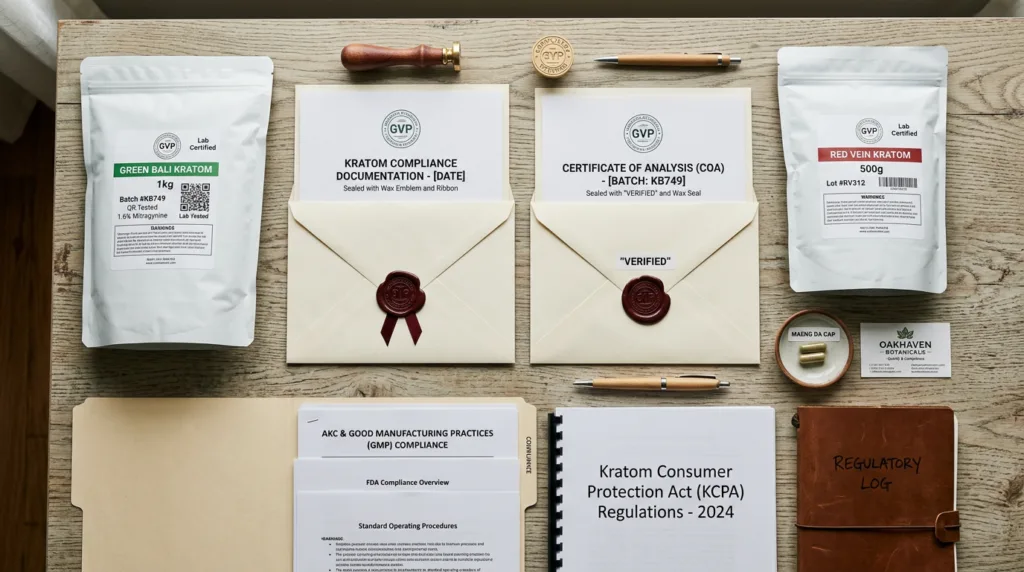
Buyers sourcing kratom for the German market benefit from a supplier that can provide clear export documentation to support internal compliance review — see Borneohale for lab-verified batch documentation and export credentials.
Commercial Risks of Non-Compliance in the German Market
Treating Germany’s unregulated status as permanent creates avoidable exposure. Marketing copy or resale listings that describe kratom as safe for human consumption can trigger food-safety or medicinal-product enforcement, even though the raw material itself is unscheduled — the labeling requirement is not optional.
Buyers relying on outdated information, like the incorrect “2025 court ban” claim, risk making sourcing decisions based on a regulatory picture that never existed. And because BfArM’s classification review is ongoing, a distribution plan built with no contingency for a future food reclassification carries the same category of risk the Netherlands market already demonstrates.
Build a Compliance Checklist for the German Market
Before treating Germany as a stable long-term market, confirm three things: that product labeling consistently states “not for human consumption” across packaging and online listings, that marketing materials make no consumption or health claims, and that you have a process for monitoring BfArM announcements for changes to kratom’s classification.
Revisit this checklist on the same schedule as any other European market review — quarterly is reasonable — and immediately after any BfArM communication referencing kratom.
FAQ: Kratom Legality in Germany for B2B Buyers
Is kratom legal to buy and sell in Germany?
Yes. Kratom is not listed under Germany’s Narcotic Drugs Act (BtMG) or Medicinal Products Act (AMG), so buying, selling, and importing it are currently permitted.
Do I need a license to sell kratom in Germany?
No specific kratom license is currently required, since kratom is unregulated. Products must be labeled “not for human consumption” and cannot be marketed as a food, supplement, or consumable.
What labeling is required for kratom sold in Germany?
Kratom products sold in Germany must be labeled “not for human consumption.” Marketing copy should avoid any language suggesting the product is intended for oral consumption or health use.
Could Germany ban kratom in the future?
There is no ban currently in place or announced. Germany’s drug authority, BfArM, issued a health warning in July 2025 and is reviewing whether kratom should be classified as a medicinal product or food — a process worth monitoring, but not a current restriction.
Is kratom classified as a novel food in Germany?
Not currently. Germany has not applied the EU Novel Food Regulation to kratom the way Dutch authorities have. If BfArM’s ongoing review results in a food classification, that exposure could become relevant — buyers should monitor this as an open item rather than a settled question. See our full guide: Is Kratom Legal in the Netherlands?
Discover more from Borneohale
Subscribe to get the latest posts sent to your email.

You may also like these articles…
Story
Kratom For Treating Mood Disorders Effectively
The potential psychological effects and therapeutic applications of Kratom. The leaves of the Mitragyna speciosa[Read More]
Read MoreGuide
How to Find Trusted Kratom Supplier in the Midst of the COVID-19
The impact of Covid-19 has been increasing since 2020. One of the most noticeable changes[Read More]
Read MoreBest Seller Product
Kratom
Green Kratom Powder
Kratom
Red Kratom Powder
Kratom
White Kratom Powder