
Aug
European kratom regulations are fragmented across 32 countries, with no unified European Union law governing the plant. For B2B buyers, importers, and resellers evaluating the European market, that fragmentation is not a minor detail — it is the single biggest variable in deciding where product can legally move, be warehoused, or be resold.
Unlike the United States, where kratom is regulated state by state under a single federal framework, Europe layers two separate legal systems on top of each country’s own narcotics law. Buyers who only check one of those systems can still end up with a shipment held at the border. This guide summarizes what B2B buyers currently need to know before committing inventory to European markets.
Table of Contents
Why European Kratom Regulations Matter to B2B Buyers
European kratom regulations are set independently by each country, and there is currently no unified EU legislation classifying kratom one way or the other. That means a product that clears customs in one member state can still be restricted, delayed, or seized in a neighboring one.
For importers and resellers, the practical question is rarely “is kratom legal in Europe.” It is whether a specific destination country, import pathway, and product format can support the shipment being planned. Two buyers importing the same leaf powder into two different EU countries can face completely different rules.
7 Critical Facts About Kratom Legality in Europe
These seven facts summarize the current regulatory landscape across Europe, based on legislative sources tracked by industry and regulatory bodies as of mid-2026.
1. Two separate legal pathways apply: narcotics law and EU Novel Food
Most discussion of European kratom regulations focuses on narcotics law — whether a country has scheduled kratom or its alkaloids as a controlled substance. That is only half the picture.
Under EU Regulation 2015/2283 on novel foods, any food ingredient without a documented history of significant human consumption in the EU before 15 May 1997 requires authorization before it can be marketed as food. Kratom does not currently have that authorization. A country can treat kratom as unscheduled under narcotics law and still restrict it through food safety enforcement.
Buyers who only screen destination countries against narcotics schedules can miss this second, separate basis for a shipment being detained.
2. Most of Europe restricts or bans kratom outright
Of the European countries commonly tracked for kratom policy, roughly two-thirds classify kratom as illegal or tightly controlled. Countries with a full prohibition include France, Italy, Poland, Switzerland, Croatia, Slovenia, Slovakia, Serbia, Romania, Bulgaria, Cyprus, Estonia, Latvia, Lithuania, Ireland, and Greece (banned March 2025). Finland, Norway, Portugal, and Sweden classify kratom as a controlled substance where import and sale are illegal, even where personal possession is treated more leniently.
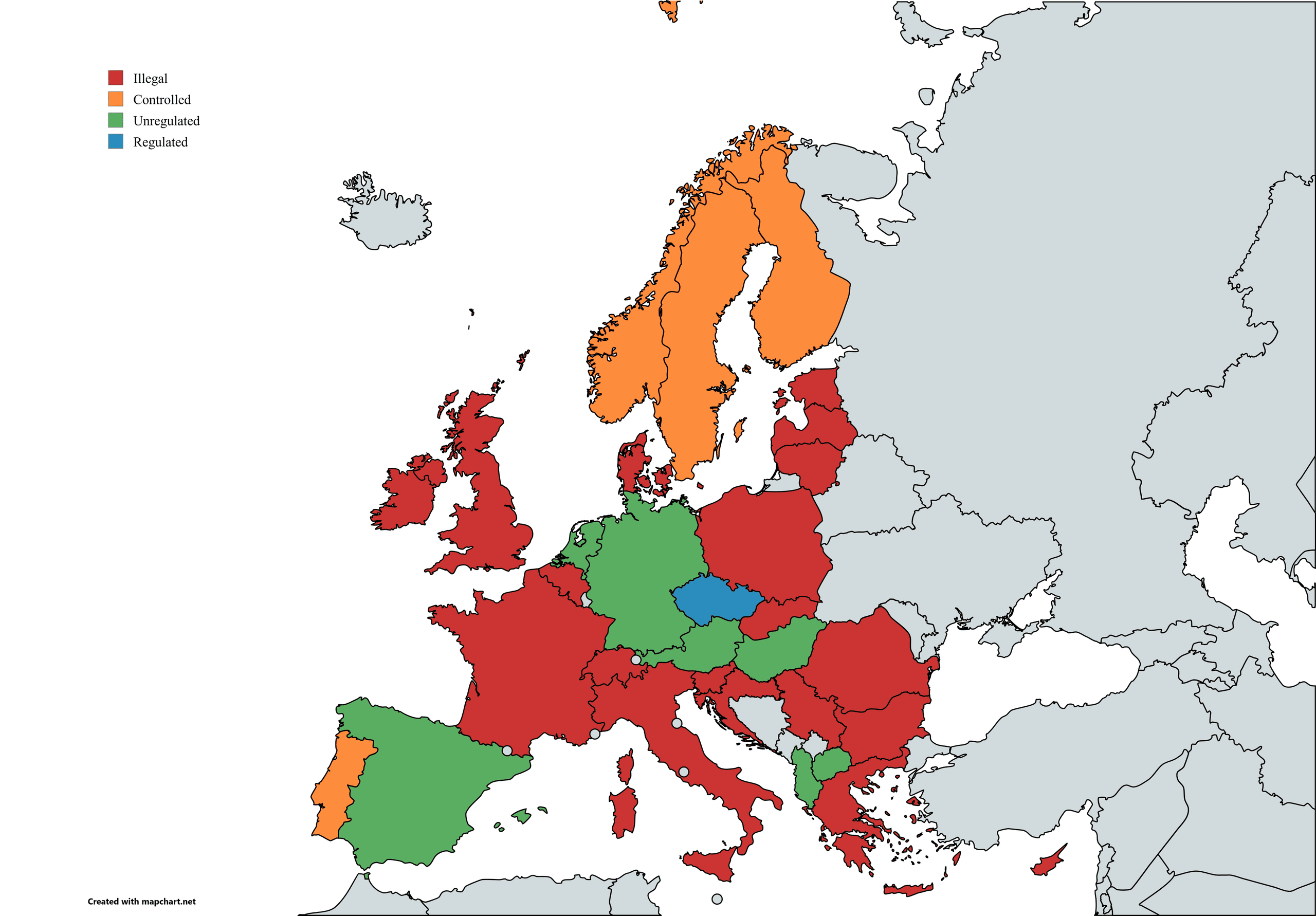
For a reseller, these markets should be treated as closed. There is no labeling workaround or product reformulation that changes a narcotics scheduling decision.
3. The Netherlands: legal under narcotics law, but Novel Food rulings create import risk
Kratom is not scheduled under the Dutch Opium Act, so it is not a controlled substance in the Netherlands. However, in June 2025 the Dutch Trade and Industry Appeals Tribunal (CBb) ruled that kratom is correctly classified as an unauthorized novel food, upholding a food safety authority’s detention of a 1,100 kg commercial import shipment.
That is precisely the volume profile many B2B buyers work with. A shipment can be fully compliant with Dutch narcotics law and still be detained on food-safety grounds. Buyers importing bulk volumes into the Netherlands should confirm their import pathway and intended product classification before committing to a shipment of that scale. For a full breakdown of the CBb ruling and what it means for bulk shipments, see our dedicated guide: Is Kratom Legal in the Netherlands?
4. Czech Republic: Europe’s only regulated kratom market
The Czech Republic is the only European country that regulates kratom through a dedicated legal category rather than banning it or leaving it unaddressed. Under Act No. 321/2024 Coll., kratom became a “psychomodulatory substance” from 1 January 2025, with full enforcement from 12 November 2025.
The framework requires licensed specialty retail, mandatory age verification (18+), standardized labeling, batch-level lab testing, track-and-trace documentation, and a Ministry of Health permit. Online sales are permitted only through licensed e-shops linked to a physical license, and advertising is prohibited.
For B2B buyers, this means Czech resellers must hold the appropriate license before a wholesale relationship can proceed. It also means marketing activity should not target the Czech market directly, since advertising kratom there is restricted regardless of the seller’s location. For a full breakdown of the Czech Republic’s licensing, labeling, and advertising rules, see our dedicated guide: Is Kratom Legal in the Czech Republic?
5. Germany and Spain: unregulated, but labeling requirements apply
Germany and Spain are both unregulated markets — kratom is not listed under Germany’s Narcotic Drugs Act (BtMG) or Medicinal Products Act (AMG), and it is not classified as a controlled substance under Spain’s controlled substances list. In both countries, product cannot be marketed for human consumption and is typically labeled accordingly.
Germany’s federal drug authority, BfArM, issued a health warning in July 2025 and is reviewing whether kratom should eventually be classified as a medicinal product or a food — the latter would expose Germany to the same Novel Food pathway already applied in the Netherlands. No ban is currently in place, but buyers active in Germany should treat this review as an open item to monitor rather than a closed question. For a full breakdown of Germany’s labeling rules, the BfArM review, and a common legal myth worth debunking, see our dedicated guide: Is Kratom Legal in Germany?
6. Regulatory momentum is still shifting
European kratom regulations are not settled. Greece added kratom to its controlled narcotics schedule as recently as March 2025. Sweden tightened its existing import and sale restrictions in March 2025. In the Czech Republic, the Prime Minister publicly called for an outright ban in early 2026; parliament rejected the proposal, but the regulated framework remains under active political scrutiny.
None of this is unusual for an emerging botanical product category, but it means a country’s status should be treated as time-stamped, not permanent. A market that is open today can close with little notice.
7. Supplier documentation supports market-access decisions
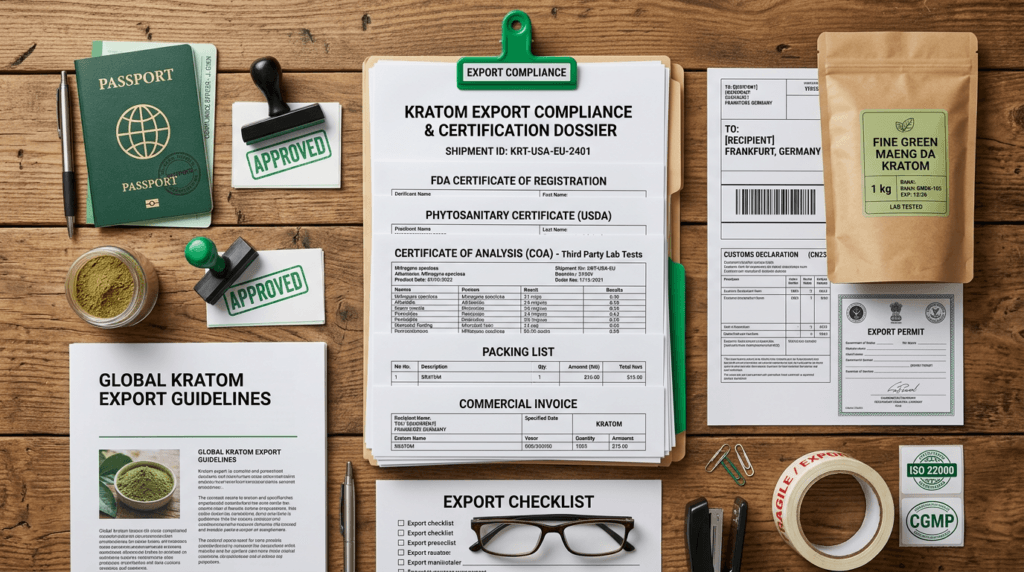
A supplier cannot determine a buyer’s legal obligations in a given European country, but strong export documentation gives buyers the underlying data their own compliance review depends on — alkaloid content, batch traceability, and independent lab verification.
For buyers seeking a structured Indonesian sourcing partner, Borneohale ships under a registered Indonesian export license, with independent lab certification (Laporan Surveyor) issued for shipments of 500 kg and above. Product specifications and documentation expectations should be agreed with any supplier before production and shipment.
Commercial Risks of Ignoring European Kratom Regulations
Overlooking European kratom regulations creates commercial exposure beyond a single blocked shipment. A detained container ties up capital while demurrage fees accrue. A reseller operating without the required license in a regulated market like the Czech Republic risks the relationship being unwound entirely. A shipment cleared on narcotics grounds can still be detained under Novel Food rules, as the Dutch case shows.
These risks compound for buyers operating across multiple countries at once. A compliance approach built for one market rarely transfers cleanly to the next.
Create a Repeatable Regulatory Review Process
Given how unevenly European kratom regulations are applied, the most reliable approach is a standing review process rather than a one-time check. Before entering any new European market, confirm the narcotics-law status, check whether Novel Food enforcement applies, verify any licensing or labeling requirements, and record the date and source of that review.
Revisit that record on a fixed schedule — quarterly is reasonable given how quickly individual countries have moved in 2025 and 2026 — and immediately after any news of legislative activity in a target market.
FAQ: European Kratom Regulations for B2B Buyers
Is kratom legal in Germany?
Yes. Kratom is unregulated in Germany — it is not listed under the Narcotic Drugs Act or the Medicinal Products Act. Products must be labeled “not for human consumption,” and German authorities are reviewing kratom’s long-term classification. See our full guide: Is Kratom Legal in Germany?
Is kratom legal in the Netherlands?
Kratom is not a controlled substance under Dutch narcotics law, but a 2025 court ruling classified it as an unauthorized novel food and upheld the detention of a 1,100 kg import shipment. Buyers should verify their import pathway before shipping bulk volumes into the Netherlands. See our full guide: Is Kratom Legal in the Netherlands?
Which European countries have banned kratom?
Countries with a full prohibition include France, Italy, Poland, Switzerland, Croatia, Slovenia, Slovakia, Serbia, Romania, Bulgaria, Cyprus, Estonia, Latvia, Lithuania, Ireland, and Greece. Finland, Norway, Portugal, and Sweden classify it as a controlled substance where import and sale are illegal. This list changes; always confirm current status before shipping.
Do I need a license to import kratom into the Czech Republic?
Yes. The Czech Republic regulates kratom as a “psychomodulatory substance,” requiring licensed specialty retail, a Ministry of Health permit, batch lab testing, and age verification. Advertising is prohibited. Resellers should hold the required license before a wholesale relationship proceeds. See our full guide: Is Kratom Legal in the Czech Republic?
Can a kratom supplier guarantee legal compliance in every European country?
No. Legal status depends on the destination country, import pathway, product classification, and current legislation, all of which can change. A supplier can provide export documentation and lab verification, but buyers should confirm market access with qualified legal counsel for their specific destinations.
Discover more from Borneohale
Subscribe to get the latest posts sent to your email.

You may also like these articles…
Health
Easy Guide to the Best Kratom Dosage
It is difficult to know how much Kratom dosage to take for diverse effects. There[Read More]
Read MoreStory
Maeng Da Kratom: The Best for Pain Relief
Experienced Kratom must have known Maeng Da as one of the most unique strains. The[Read More]
Read MoreBest Seller Product
Kratom
Green Kratom Powder
Kratom
Red Kratom Powder
Kratom
White Kratom Powder