
Aug
Legal
US Kratom Regulatory Compliance: 7 Essential Steps for Reliable State-Level Supply
US kratom regulatory compliance requires international suppliers to react quickly when an individual state changes its approach to kratom products. A reported 14-day notice window connected with the Massachusetts case illustrates why exporters need a documented stop-shipment and buyer-notification process before goods are dispatched—not after they reach a U.S. warehouse.
For B2B suppliers, the core issue is not simply whether a product can enter the United States. It is whether a specific product, formulation, customer, destination state, and fulfillment route remain legally workable at the time of sale, shipment, delivery, and resale.
The Massachusetts example should be treated as a compliance scenario requiring verification from primary legal and agency sources. The Commonwealth has published an official announcement concerning action on kratom products, available through Mass.gov. Importers and exporters should confirm the operative order, exact scope, effective date, and any subsequent amendment with qualified U.S. legal counsel.
Table of Contents
Why US Kratom Regulatory Compliance Must Be State-Specific
The United States is not a single regulatory destination for kratom supply. Federal rules, state laws, local requirements, retail restrictions, and enforcement priorities may differ. A product accepted by a distributor in one state may create contractual, warehousing, or resale risks in another.
For international exporters, US kratom regulatory compliance must therefore be managed at the destination level. The relevant destination is not always the importer’s registered address; it may be the consignee, third-party logistics warehouse, distributor territory, or final retail market.
Community discussions around the Massachusetts situation show that market participants can be uncertain about whether a regulatory action affects retail sales, online sales, possession, wholesale distribution, or all commercial activity. That uncertainty is itself a supply-chain risk. Suppliers should not rely on customer assumptions or social-media interpretations when deciding whether to release cargo.
Massachusetts as a Cross-Border Supply Chain Case
A sudden state-level action can affect multiple points in the chain at once: purchase orders already confirmed, containers in transit, stock held by a 3PL provider, and inventory allocated for future customer deliveries. The Massachusetts case demonstrates why a compliance review needs to begin as soon as an official announcement or credible legal notice appears.
For effective US kratom regulatory compliance, international suppliers should separate three questions:
- What products are covered, including botanical leaf powder, extracts, blends, alkaloid-enhanced items, or finished consumer goods?
- Which commercial activities are restricted, such as importation, manufacture, wholesale transfer, retail sale, shipment, or possession?
- When does the rule take effect, and is there a transition period for stock already ordered or delivered?
These questions should be answered from official orders, statutes, agency guidance, and advice from competent legal professionals—not from customer messages, forum commentary, or headlines alone.
7 Steps for US Kratom Regulatory Compliance During State Changes
1. Create a destination-state product matrix
Maintain a live matrix that maps every U.S. buyer and shipping destination to the product categories they purchase. Include plain leaf material, powders, capsules, extracts, private-label products, and any products with declared alkaloid specifications.
This matrix makes US kratom regulatory compliance operational. When a state action occurs, the supplier can identify affected SKUs and purchase orders without reviewing every invoice manually.
2. Verify the legal source before placing inventory on hold
Start with the state legislature, governor’s office, health department, attorney general, or other designated regulator. Record the source URL, publication date, stated effective date, and the exact legal language used.
An announcement may explain policy direction, while an emergency regulation, administrative order, or statute may define the enforceable scope. A buyer’s interpretation should never substitute for a source review.
3. Segment botanical material from enhanced or concentrated products
Do not assume every kratom-related product is treated identically. Regulatory actions may distinguish between traditional botanical material, extracts, high-potency products, synthetic compounds, or products marketed with particular claims.
Product-level segmentation is especially important for US kratom regulatory compliance because a broad internal “kratom” label can hide meaningful differences in formulation, documentation, and commercial risk.
4. Freeze affected orders using a written trigger
Use predefined internal triggers. For example, a supplier may temporarily pause release of inventory when an official notice names a destination state and a product category under review.
A hold should cover new orders, pending dispatches, and stock earmarked for an affected consignee. It should also identify whether cargo already handed to a carrier requires rerouting, storage, return, or instructions from the importer of record.
5. Notify buyers with neutral, documented language
Communicate quickly, but do not make unsupported legal conclusions. State that the supplier is reviewing an official development, identify the relevant shipment or SKU, and explain whether fulfillment is paused pending verification.
Strong US kratom regulatory compliance communications should ask the buyer to confirm their intended destination, legal review status, and preferred inventory instruction. Keep all confirmations in the order file.
6. Review contracts, Incoterms, and inventory ownership
State changes can expose unclear contract terms. Suppliers should know when title transfers, who acts as importer of record, who controls goods in a U.S. warehouse, and which party bears costs for diversion or return.
Purchase agreements should address regulatory-change events, cancellation rights, storage fees, payment obligations, and the handling of non-deliverable stock. This is a commercial safeguard, not a substitute for legal advice.
7. Preserve a complete compliance file
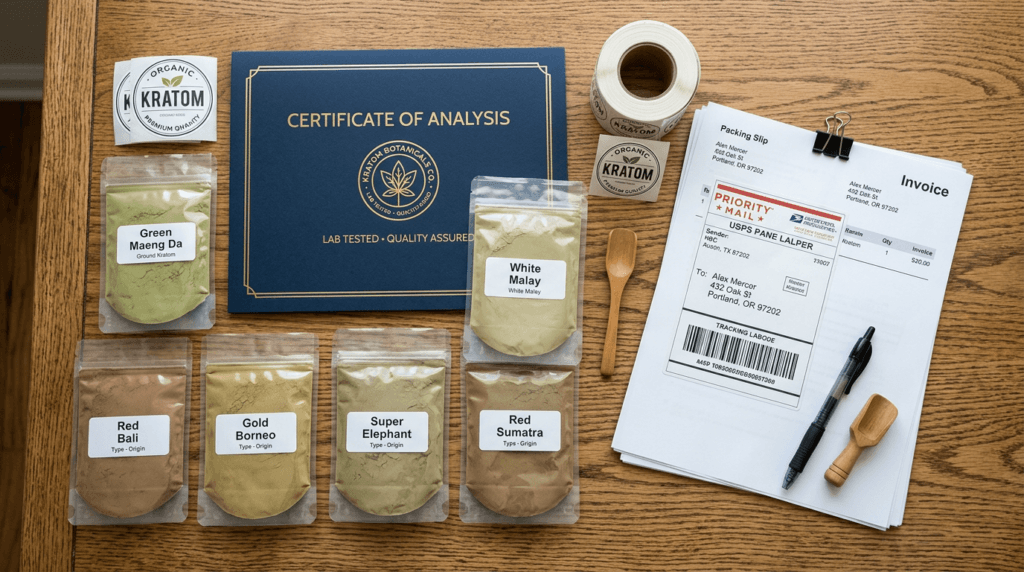
For each affected shipment, retain the official source, product specification, certificate of analysis, lot number, invoices, customer correspondence, shipping documents, and internal decision record. This helps demonstrate that the exporter took a structured, good-faith approach to compliance.
International suppliers should also retain proof of the product’s declared composition and quality controls. For general federal context, buyers may consult the U.S. Food and Drug Administration’s kratom information page, while recognizing that federal information does not replace state-specific legal review.
Documentation That Supports US Kratom Regulatory Compliance
Documentation does not make a prohibited transaction permissible. However, organized records allow exporters and buyers to assess product scope accurately and respond faster when regulatory conditions change.
A practical B2B file should include:
- Commercial invoice and packing list with precise product descriptions
- Batch and lot traceability records
- Current certificates of analysis from an appropriate laboratory
- Product specifications, including declared alkaloid information where applicable
- Destination-state and customer confirmation records
- Shipping instructions, Incoterms, and importer-of-record details
- Written regulatory-review decisions for paused, rerouted, or cancelled orders
A supplier’s quality and traceability program should be designed before a regulatory event occurs. Businesses sourcing Indonesian material can discuss documented bulk supply processes with Borneohale, while remaining responsible for confirming the laws applicable to their own destination markets.
Building a Regulatory Response Plan Before the Next Change
The Massachusetts scenario is a reminder that a state-level development can move faster than an international shipping cycle. Sea freight, customs processing, domestic warehousing, and distributor allocation may take substantially longer than a short regulatory notice period.
For this reason, US kratom regulatory compliance should be assigned to a named internal owner or external legal adviser. The responsible party should have authority to pause affected shipments and access to current buyer, SKU, warehouse, and carrier data.
Suppliers should conduct periodic reviews with U.S. distributors, especially before accepting large recurring orders or private-label production commitments. A disciplined plan protects both parties by reducing the risk of inventory being delivered into a market where resale conditions have changed.
FAQ: US Kratom Regulatory Compliance for International Suppliers
Can an international supplier ship kratom to the U.S. if one state changes its rules?
Possibly, but the answer depends on the shipment’s destination, product type, applicable federal requirements, and the relevant state rules. Confirm the current legal position before dispatch.
Does a state rule affect goods stored in another U.S. state?
It may affect inventory intended for resale or delivery into that state. Suppliers should track final destination, not only the location of the warehouse.
What should suppliers do with orders already in transit?
Review the shipment status, contract terms, carrier options, and destination-state requirements immediately. Obtain written instructions from the importer or buyer and seek legal advice where needed.
Are botanical kratom leaf products always treated the same as extracts?
No. Regulatory scope can vary by product format, concentration, formulation, and stated ingredients. Maintain SKU-level specifications and verify the exact language of the applicable rule.
What is the most important first step in US kratom regulatory compliance?
Verify the official legal source and immediately identify every affected SKU, customer, shipment, and warehouse allocation before releasing additional inventory.
Discover more from Borneohale
Subscribe to get the latest posts sent to your email.

You may also like these articles…
Legal
What are Texas HB-1097 & Kratom Consumer Protection Act?
Despite the fact that kratom is legal in Texas, a number of bills have been[Read More]
Read MoreGuide
How to Find the Best Places to Buy Kratom Online
If you’re planning to buy Kratom online, you’ve probably noticed how quickly the global demand[Read More]
Read MoreBest Seller Product
Kratom
Green Kratom Powder
Kratom
Red Kratom Powder
Kratom
White Kratom Powder